














Top Level > Original Paintings (7334) / Sculptures > Martin Ulbricht
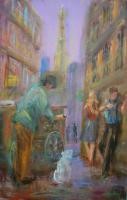
"The Flying Scotsman - Kings Cross (Farewell Alan Pegler" by Martin Ulbricht

A rare opportunity to acquire an incredible original Martin Ulbricht painting "The Flying Scotsman - Kings Cross (Farewell Alan Pegler)"
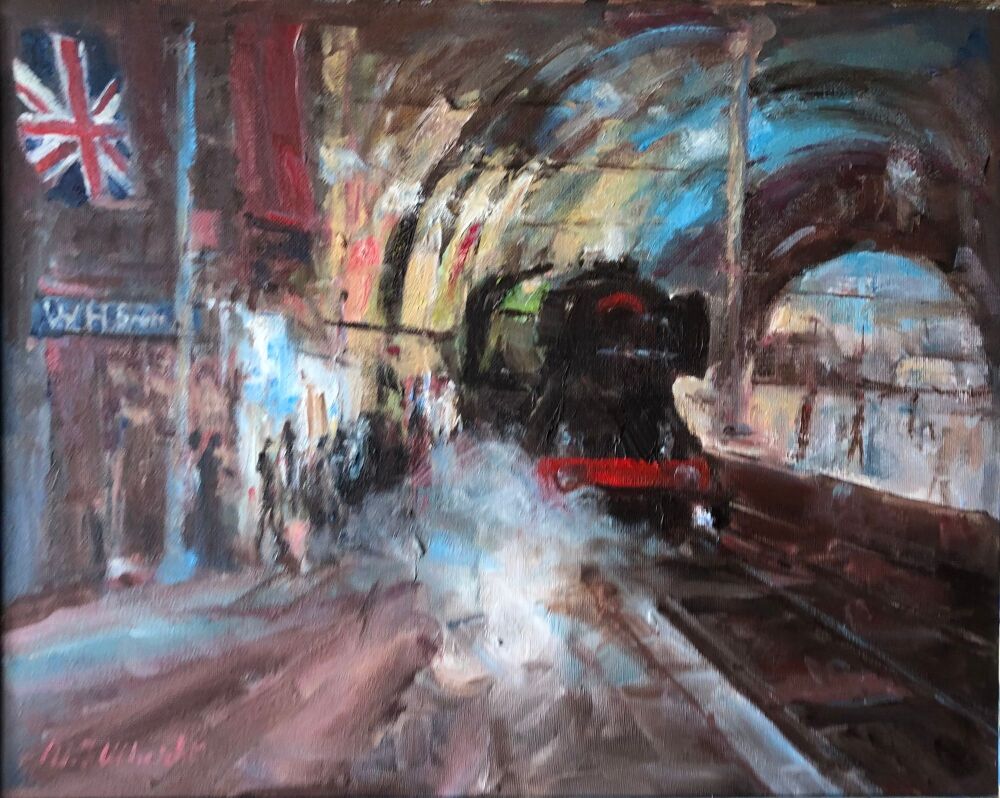
"The Flying Scotsman - Kings Cross (Farewell Alan Pegler)" by Martin Ulbricht
Alan Pegler first saw the Flying Scotsman in Wembley at the 1924 British Empire Exhibition. In 1961, he received £70,000 for his share holding when Northern Rubber was sold to Pegler's Valves, a company started by his grandfather.
In 1962, British Railways announced that they would scrap the Flying Scotsman. A group called "Save Our Scotsman" were unable to raise the £3,000 scrap value of the locomotive that would prevent this.
Pegler stepped in and bought the Flying Scotsman outright, with the political support of Prime Minister Harold Wilson. He spent the next few years spending large amounts of money having the locomotive restored at the Doncaster Works, and then persuaded the British Railways Board to let him run enthusiasts' specials. The Flying Scotsman was at that time the only steam locomotive running on mainline British Railways
Signed By Martin Ulbricht
Measurements; 16 inches x 21 inches
(40.6 cms x 53.3 cms)
Oil on Canvas
Investment
" An Amazing Blue Chip Investment Opportunity to Acquire an Original Martin Ulbricht Painting" ..
Invest in one of our paintings, rather than risky bank investments, where you can actually touch your investment. Take pleasure in looking at it and watch it appreciate in value over the years!! Remember we guarantee every painting sold is unique, original e.g only one of it's kind in the world!!!
Scarcity alone guarantees the investment !!!!
Asgard Arts offers works of art which will not only look fantastic in your home or offices (One Investment Bank in particular has purchased paintings from us for their offices see Bull paintings) but will also be a sound financial investment for the future. Art has long been regarded as a strong and safe investment. Investment in paintings was discussed recently on Bloomberg television as a sound investment as a hard asset like Gold, Platinum Silver etc. Also Ellen Kelleher a personal finance journalist for The Financial Times recently wrote an article recommending the purchase of Art, particularly in the $500 - $50,000 range as a sound long term investment with an impressive current average annual increase of 9.7 percent. Go to Latest Art news on Asgard Arts and see Hang your investments on the wall by Ellen Kelleher Published October 22 2010 in the Financial Times.

Ref only: asgard-arts.com
Martin J. Ulbricht
Born in 1948, Martin Ulbricht has painted all his life having been inspired at a young age by artistic works seen in a wide variety of exhibitions. He is largely self taught but an early inclination to pursue a career as an artist gave way to one in aviation. His years in aviation allowed him the time to continue to develop his technique and style and this period of his life provided a multiplicity of inspiration on a variety of themes.
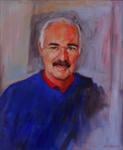
"Self Portrait"
Ulbricht has an impressionistic/realistic approach to his subject matter being inspired by places he has visited, scenes he has seen and his own mood when painting. Once he has a mental image of a subject, he likes to prepare the canvas to a ground colour to suit the image and he initially puts the whole image onto the canvas as quickly as possible. Time is then spent on the detailing and on reflection so bringing the painting up to its finished state. It is this process which enables Ulbricht to create paintings which give the viewer constant pleasure.
Edward Seago has been a major influence with regard to his use of colour, brushwork and the subjects he depicted, in particular his treatment of skies, whilst Terence Cuneo influenced Ulbricht's approach to transport based themes and John Singer Sargent has been an inspiration for Ulbricht's portraiture.
The dominant themes in his work involve views of Venice, big skies, sunsets and beaches together with genre paintings of transport images involving more technical detail. His contemporary landscapes, cityscapes, beach scenes and sunsets have become much sought after. Portraiture has always been, and still remains, an abiding passion.
Having decided to pursue a career as a professional artist, Terence Macklin's advice helped Ulbricht to be more focused with regard to his subjects. As a professional artist, Ulbricht likes to remain flexible regarding style and subject but he always stays true to his premise that, whatever the painting it must give its owner constant pleasure.
Ulbricht exhibits and sells his work through galleries in the South East, London, Lincolnshire, on the internet, at the Affordable Art Fair and by private commission.

Powered by eBay Turbo Lister
| Pay instantly with your debit or credit card through PayPal. |
 |
    
|

Contents
-
Further reading
-
External links
Hawker Tempest
| Tempest | |
|---|---|

A Tempest V, NV696, during a test flight, November 1944
|
|
| General information | |
| Type | Fighter aircraft |
| National origin | United Kingdom |
| Manufacturer | Hawker Aircraft |
| Primary users | Royal Air Force |
| Number built | 1,702[1] |
| History | |
| Introduction date | January 1944 |
| First flight | 2 September 1942 |
| Retired | 1953 |
| Developed from | Hawker Typhoon |
| Developed into | Hawker Sea Fury |
_(Art_IWM_ART_LD_4588).jpg) Painting of two Tempest aircraft attacking a V-1 flying bomb in the sky above an Oasthouse.
Painting of two Tempest aircraft attacking a V-1 flying bomb in the sky above an Oasthouse.
The Hawker Tempest is a British fighter aircraft that was primarily used in its Mk.V form by the Royal Air Force (RAF) in the later stages of the Second World War. The Tempest, originally known as the Typhoon II, was a significantly improved derivative of the Hawker Typhoon, intended to address the Typhoon's unexpected deterioration in performance at high altitude by replacing its wing with a thinner laminar flow design. Since it had diverged considerably from the Typhoon, it was renamed Tempest. The Tempest emerged as one of the most powerful fighters of World War II and at low altitude was the fastest single-engine propeller-driven aircraft of the war
-
(Top)
-
Design and development
-
Design
-
Operational history
-
Post war
-
Variants
-
Operators
-
Surviving aircraft
-
Specifications (Tempest Mk.V)
-
See also
-
References